Black Streaks, Moss and Lichen on Your Roof
Three different organisms, three different problems. One is mostly appearance. The other two lift shingles and let water in — and insurers have started paying attention.
Three Different Organisms, Not One Problem
The dark streaks running down asphalt shingle roofs across Virginia are a blue-green algae called Gloeocapsa magma. It travels by air, lands on the roof, and takes hold wherever conditions let it. What it feeds on is the limestone filler manufacturers add to asphalt shingles, which is why it grows on the roof rather than the siding.
The streaking pattern is just gravity. Spores land near the ridge and every rain carries them downward, so the colony spreads in vertical runs from the top down.
But algae is only one of three things that grow on a roof here. Moss is a plant with real mass that takes hold along shingle edges. Lichen is part algae and part fungus and bonds into the shingle surface. Most roofs with a growth problem have some combination, and the three do very different amounts of damage.
Working out which you have is the first step, because it decides whether you are looking at an appearance issue or a structural one.
Why It Shows Up on Some Roofs and Not Others
Two identical houses on the same street can have very different roofs, and it usually comes down to how long each slope stays wet.
- North-facing slopes go first. Less sun, slower drying, longer damp periods.
- Overhanging trees. Shade, retained moisture, and a steady supply of organic debris.
- Humidity. Central Virginia summers give this organism most of what it wants.
- Proximity to water. Around Smith Mountain Lake, roofs facing the water or tucked into a shaded cove tend to green up and streak noticeably faster.
- A neighbor who already has it. Spores carry on the wind. Once it is established nearby, yours is exposed.
How Much Does It Actually Matter?
It depends entirely on which organism you have, and this is where most of the advice online falls apart. Black streaking, moss and lichen get treated as one problem. They are not.
Algae — the black streaking — is the mildest of the three. It uses the limestone filler in the shingle as a nutrient source and holds moisture against the surface, so over a long enough period it can shorten shingle life. But it is slow, and a streaked roof is not an emergency.
What we will not tell you is that black streaks are spiking your power bill. Those energy-savings claims get used to close roof cleaning jobs and they are marketing. The real reasons to deal with algae are appearance, resale, and stopping a slow problem before it compounds.
Moss and lichen are a different matter entirely, and that is the part worth reading carefully.
Moss and Lichen Lift Shingles
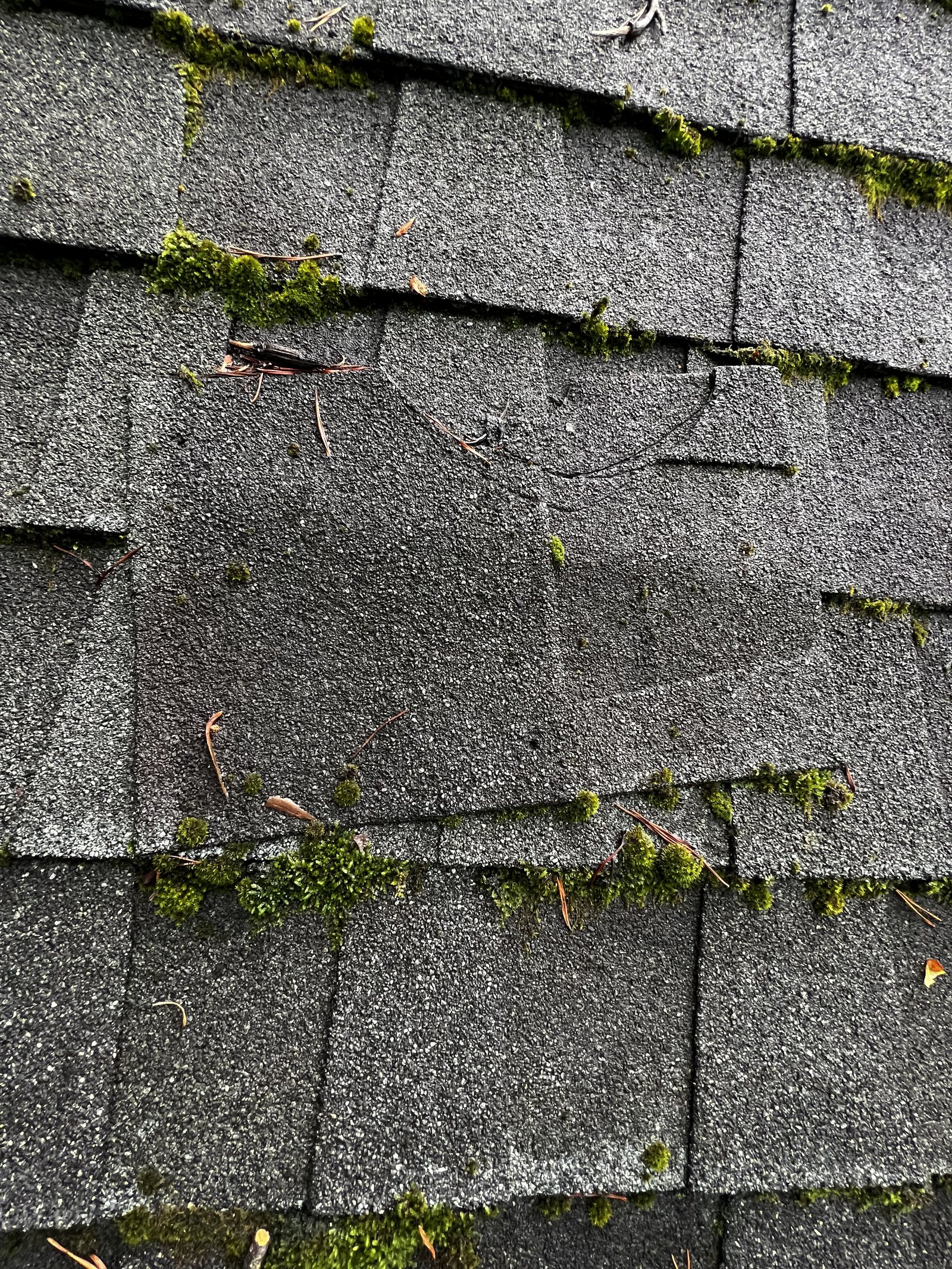
Moss is not a stain. It is a plant with structure and mass, and it grows where water sits longest — along the leading edge of each shingle course, right where one tab overlaps the next.
From there it spreads, and as it thickens it works its way underneath the tab and pushes it upward. A lifted shingle is no longer sealed to the one below it, and that creates two problems at once. Wind gets under the raised edge, which is how shingles tear off in a storm. And water gets under it too, running to places the roof was never designed to send it.
Moss also holds water like a sponge. A shingle that stays damp long after the rest of the roof has dried is a shingle aging faster than it should, and in freezing weather that trapped water expands.
Lichen is the most stubborn of the three. It is part algae and part fungus, and it bonds into the shingle surface rather than sitting on top of it. Removing lichen without damaging the shingle takes patience, and a roof left with heavy lichen long enough will show granule loss where it finally comes away.
So the honest summary: algae is mostly appearance and slow wear. Moss and lichen do structural damage, and moss on the leading edges is the one worth acting on rather than watching.
- Moss on leading edges — deal with it. This is the one that lifts tabs.
- Lichen — deal with it, and the longer it sits the more it takes with it.
- Black streaking alone — appearance, resale, and slow wear. No rush, but it will keep spreading.
Never Pressure Wash an Asphalt Shingle Roof
This is where real damage happens, and it is entirely avoidable.
The surface of an asphalt shingle is a layer of granules embedded in asphalt. Those granules are the roof’s protection from UV and weather, and they are the wearing surface. Pressure strips them off. Once they are gone they do not come back, and the shingle underneath ages far faster than it should.
Pressure also drives water up under the shingle courses, where it has no business being, and it can void a manufacturer warranty outright. The asphalt roofing industry’s own guidance advises against pressure washing shingles for exactly these reasons.
A pressure-washed roof often looks fantastic the week it is done. The cost shows up years later, when the roof needs replacing early. If someone offers to pressure wash your shingles, that is enough information about them — and if you want to see what that damage actually looks like on siding and stone, we have a guide to spotting it.
What Soft Washing Actually Does
Soft washing is not a gentler version of pressure washing. It is a different approach: the cleaning solution does the work, and water is only there to rinse.
We follow the Asphalt Roofing Manufacturers Association guidance for algae removal. ARMA is the industry body for the people who actually make shingles, and their position is unambiguous: a low-pressure application with the right cleaning solution and a thorough rinse. Not pressure.
The solution kills the algae at the root rather than blasting the visible growth off the surface. Applied at low pressure — roughly what a garden hose delivers — nothing is scoured, no granules are displaced, and nothing is forced under the shingles.
Because the organism is killed rather than knocked loose, the roof also stays clean considerably longer than a stripped one. A roof that has been blasted often streaks again quickly, since the colony was never actually dealt with.
The rest of the job is care around the roof: protecting plantings, controlling and rinsing runoff, and keeping solution off things it should not touch. That part is unglamorous and it is most of the work.
If you want to see it on a real roof rather than described, there is a full write-up of a roof cleaning we did in Moneta, and the details of how we approach the work are on our roof cleaning page.
Your Insurance Company May Force the Issue
This has changed in the last few years and most homeowners have not heard about it yet.
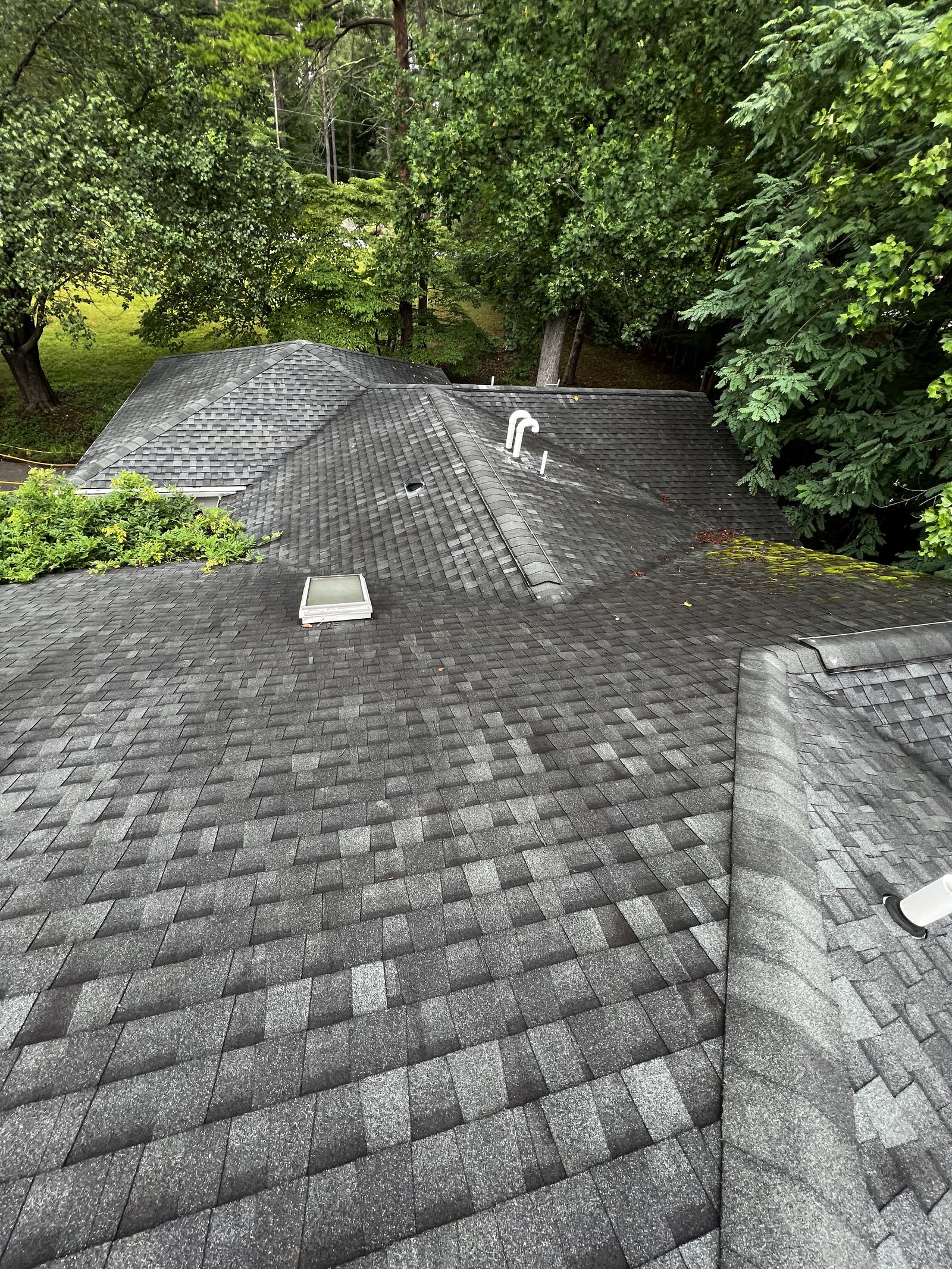
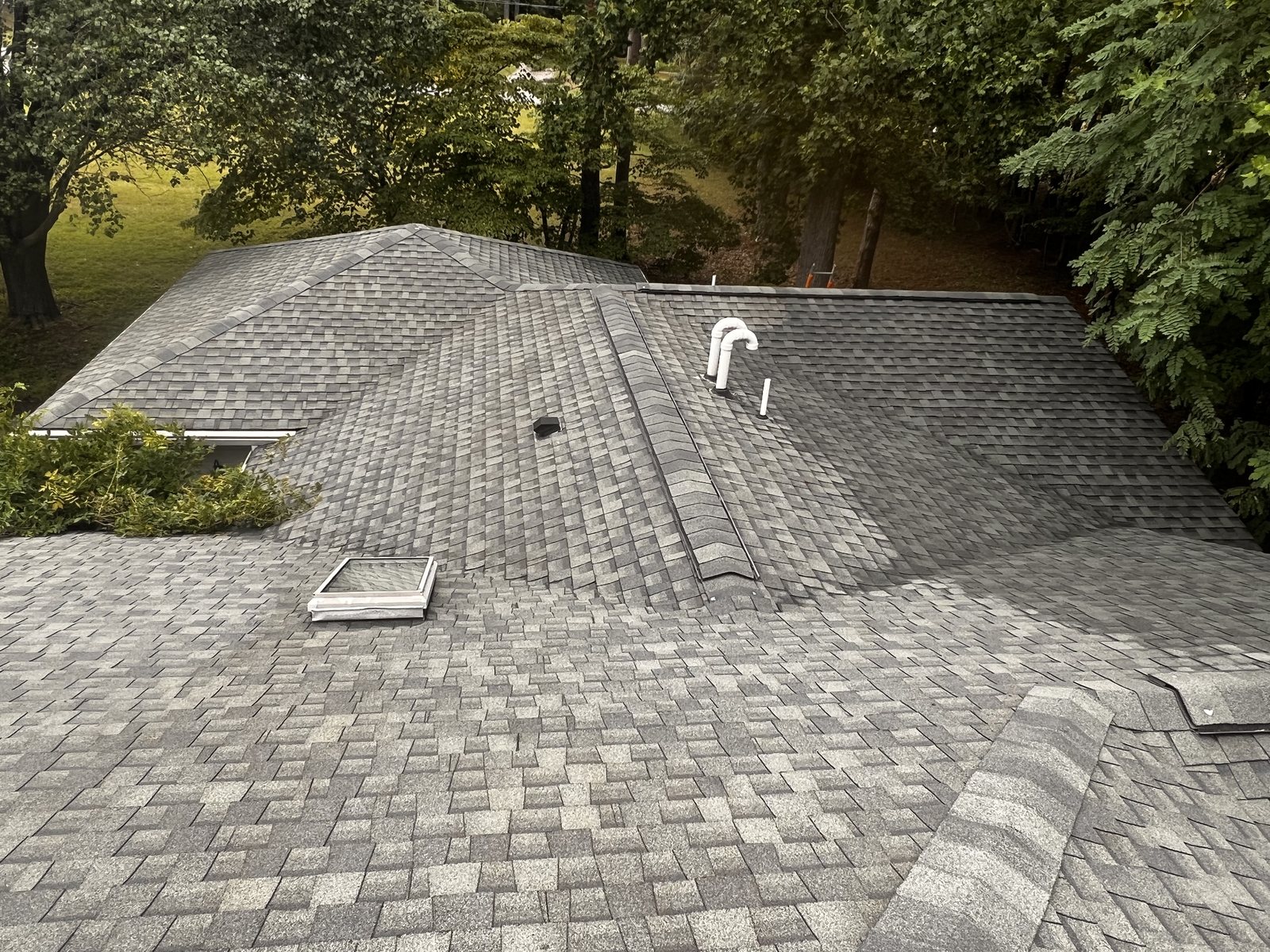
Carriers have tightened up on roof condition. Assessments now happen by aerial and satellite imagery as well as in person, which means your roof does not have to be looked at from a ladder to be judged. Where heavy organic growth, moss, or visible deterioration show up, some carriers treat it as deferred maintenance rather than an optional improvement.
We have cleaned roofs here specifically because a homeowner’s insurance required it. We have also seen a non-renewal notice where the stated reason was natural discoloration and streaking on the roof, said to increase the risk of future loss.
That is worth understanding properly, because the wording frightens people more than it needs to. A notice like that talks about repairing the affected area of the roof and submitting documentation that it has been done. When the condition cited is discoloration and streaking, the discoloration is the damage — and cleaning the roof properly is what repairs it. You clean it, you document it, you send it to your agent.
So the good news is that this is usually fixable for a fraction of what the letter makes it sound like. The bad news is that these notices come with a deadline, and ignoring one does end in non-renewal. A roof wash costs a small fraction of a roof, and a great deal less than shopping for a new carrier with a non-renewal on your record.
We are not insurance advisors and every policy is different, so read yours and talk to your agent. But if a notice has arrived, it is not a scare tactic and it will not resolve itself.
The Best Time Is When You First See It
There is no season you have to wait for. Unlike sealing, which needs a dry surface and a warm cure window, roof cleaning works through most of the year here — it needs a reasonable temperature and no hard freeze, and that is about the extent of it.
So the answer to when is simple: when you first notice it. The moment you can see streaking from the driveway, or green showing along a shaded edge, that is the point to deal with it. Waiting for a particular month accomplishes nothing except giving the growth more time.
That matters most with moss. Moss does not pause for the calendar, and every season it spends on the roof is more of it working under the shingle tabs. Catching it while it is still along the edges is a straightforward cleaning. Letting it run for another year or two is a different job.
How often depends on your roof rather than a rule. Heavy shade, dense tree cover, or a north slope near the water will need it more frequently; an open, sunny roof will go longer. Most roofs around here get several years out of a proper cleaning, because killing the organism is not the same as knocking the visible growth off. We stand behind that with a 3-Year Streak-Free Guarantee — if black streaks come back within three years, we re-treat at no charge. That covers streaking specifically; moss and lichen are different organisms and how fast they return depends heavily on tree cover.
If your insurance carrier has raised it, that sets the timeline for you. Do not wait — get it looked at, get it done, and keep documentation of the work.
Common Questions
What is the difference between algae, moss and lichen?
Algae is the black streaking and it is the mildest. Moss is a plant with real mass that grows along shingle edges and lifts the tabs, which leads to wind damage and water intrusion. Lichen is part algae and part fungus and bonds into the shingle surface, making it the hardest to remove cleanly. They often turn up together, and they are not equally urgent.
Will the streaks come back?
Eventually, yes. The spores are airborne and nothing applied to a roof keeps them off permanently. What changes is the timeline: killing the organism rather than blasting the visible growth off buys you years rather than months. Shade and tree cover are the biggest factors in how quickly it returns.
My insurance company sent a letter about my roof. What now?
Do not sit on it, and do not panic either. Carriers now assess roof condition by aerial imagery as well as in-person inspection, and these notices carry a deadline. If the notice specifically cites discoloration, streaking or organic growth, professional cleaning may satisfy the condition without roof replacement — but confirm the required corrective action with your agent or carrier before you have any work done. Whatever you have done, document it with before and after photos and send that documentation in.
Is soft washing safe for my plants and gutters?
It is, when the job is done properly, and that is genuinely most of the work. Plantings get wet down before and rinsed after, runoff is managed and diluted, and gutters and downspouts are rinsed rather than left to hold solution. Anyone who turns up and simply starts spraying is skipping the part that protects your landscaping.
More From Pro-Shine
Written by Chuck Terry, owner of Pro-Shine Softwash in Moneta, VA. Pro-Shine has 10+ years of exterior cleaning experience serving Smith Mountain Lake and the surrounding communities across Bedford, Franklin and Roanoke counties. Chuck is a Trident Master Certified Applicator and visits every job in person before quoting it.
Ready to Get the Streaks Off?
Every estimate is free and done in person. Call or request a quote and we will come take a look.
Tell us about your project and we'll get back to you fast — usually within a few hours.
No obligation. No high-pressure sales — or high-pressure washing.