Best Time to Wash & Seal in Virginia
These are two different questions with two very different answers. Washing works nearly year round here. Sealing has real numbers attached to it, and missing them is how a job fails months later.
Washing Is Flexible. Sealing Is Not.
If you want a house, roof, or driveway cleaned, the window is wide. We work through most of the year in this area and the limits are practical rather than seasonal — a hard freeze, or heavy rain on the day.
Sealing is a different job. A sealer has to cure, and curing is a chemical process with conditions attached. Get those wrong and the coating can cloud, stay soft, or fail early — not that week, but a season or two later when you have forgotten anything was ever borderline.
So the useful answer is not a month. It is a set of numbers, and they are worth knowing before anyone quotes you.
What Actually Has to Be True Before We Seal
These come from the manufacturer’s published specification for the two-part urethane we use, and from what we have found holds up in this area.
- Never on a wet surface. Standing or pooled water dilutes the sealer, and diluted sealer will not cure the way it is meant to. Trapped moisture is also the usual cause of a coating going milky white — that is covered in detail in our guide to sealer that turns white or cloudy.
- No work in rain or strong wind. Wind carries sealer where it should not go and rain ruins an uncured film.
- Not in blazing heat either. Above about 120°F surface temperature the sealer skins over before it can level out.
Sealing Conditions
- Temperature: 45–95°F, and that means day and night, not just the warm part of the afternoon
- Minimum before we start: at least 40°F held for the 24 hours prior
- Surface must be dry: 24 hours minimum after cleaning or rain when we are stabilizing joint sand
- Full cure: 24–36 hours depending on weather
- Back on it: foot traffic at 24 hours, vehicles at 48
- New concrete: wait 7 days after it is poured before sealing anything
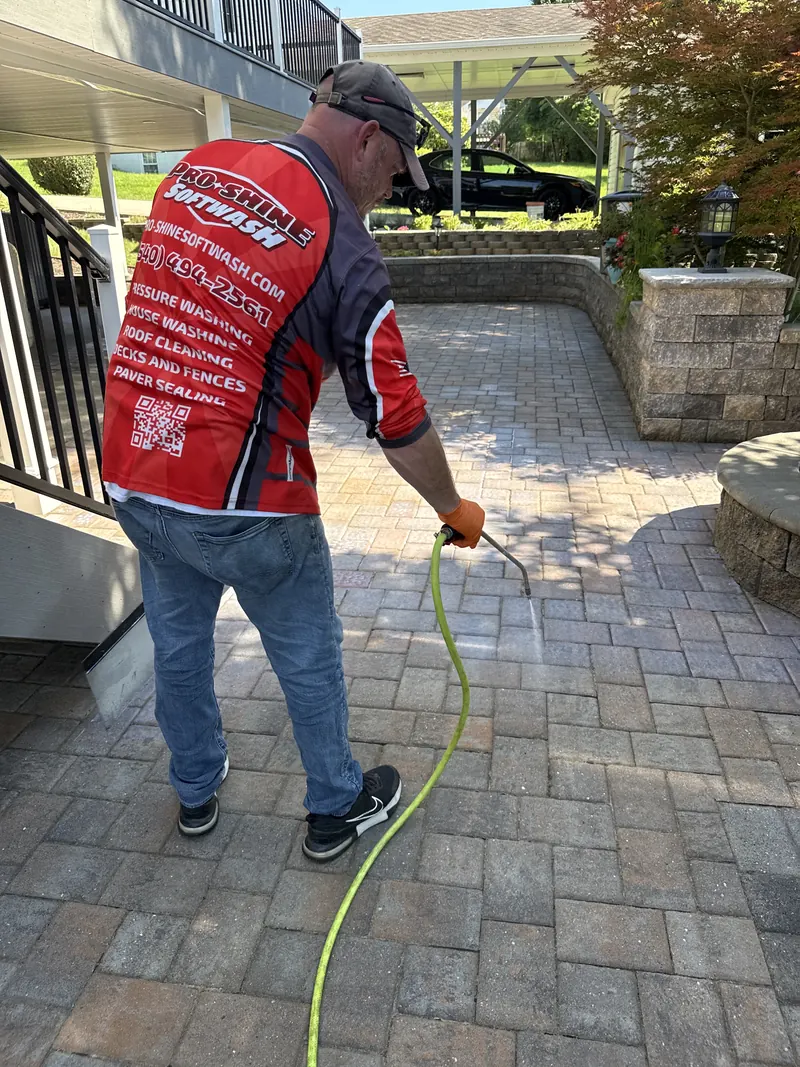
Ground Temperature Matters as Much as Air Temperature
This is the thing that catches homeowners — and, honestly, catches contractors who should know better.
A day in late October can hit 55°F at two in the afternoon and feel like perfectly good sealing weather. But if it drops to 39°F that night, the surface has been cold all along and will be cold again within hours. Concrete and pavers hold temperature far longer than air does. The slab is not 55°F just because the thermometer on your porch is.
The manufacturer specifies day and night temperatures inside the range for exactly this reason. A coating that goes down in a narrowing window can look perfect on the day and be compromised underneath.
That is why we watch the overnight low as closely as the forecast high, and why we will tell you to wait rather than squeeze a job into the end of a season. A sealer job you have paid for should last years, not until the first hard winter.
Why Cleaning Has a Much Wider Window
Nothing is curing when we wash a house or a roof. The solution does its work, we rinse it, and the surface dries. There is no chemical reaction that a cold night can interrupt.
What actually limits washing here is freezing — water on surfaces and in equipment — and heavy rain on the day itself. Outside of that, most of the calendar is available.
If anyone tells you house washing or roof cleaning can only be done in one season, ask them why. Organic growth does not wait for spring, and neither should a roof with moss lifting the shingle tabs.
How to Think About Scheduling
If the job includes sealing, aim for a stretch with settled weather and overnight lows comfortably inside the range — not scraping the bottom of it. Book earlier rather than later in the season; the good windows fill up and the marginal ones are not worth taking.
If it is cleaning only, there is far less to plan around. Call when you notice the problem.
Either way, we look at the surface before quoting. Weather is only half of it — the condition of the surface, what is already on it, and how the site drains all change what we would recommend.
If you want to see a job where all of this lined up, there is a full write-up of a paver clean, sand and seal in Huddleston — cleaned, re-sanded, and sealed inside a good weather window.
When We Will Tell You to Wait
We would rather turn a job down than put sealer on a surface that cannot cure properly. It is a bad trade for both of us: you pay for something that fails, and we get the phone call about it.
The times we say wait: overnight lows dropping under the range, rain inside the cure window, a surface that has not had long enough to dry after cleaning, or new concrete that has not had its seven days.
None of that is a scheduling problem you need to solve. Tell us what you want done and we will tell you whether this is the week for it.
We are a Trident Master Certified Applicator and we follow the manufacturer’s specification for the products we install. The numbers above are theirs, not marketing.
Common Questions
Can you seal in the fall?
Often yes, but it depends on the overnight lows rather than the date. A mild fall with nights staying comfortably above 45°F gives good sealing weather. A cold snap that drops nights into the thirties ends the window regardless of how warm the afternoons are. We watch the forecast and tell you honestly.
What happens if sealer is applied when it is too cold?
The film cannot form and cure the way it is designed to. It can stay soft, cloud, or wear far faster than it should. The frustrating part is that it often looks fine on the day — the problem shows up a season or two later, at which point the fix is stripping rather than a touch-up.
How long before I can use the surface again?
Foot traffic at 24 hours and vehicles at 48, weather depending. We will give you the specific timing for your job before we leave, because a driveway resealed in cool damp weather needs longer than the same driveway in July.
Is there any time of year you cannot wash a house?
Very little. Hard freezes stop us because of water on surfaces and in the equipment, and we do not work in heavy rain. Beyond that the window is wide, and waiting for a particular season usually just means more growth to remove when we get there.
More From Pro-Shine
 Written by Chuck Terry, owner of Pro-Shine Softwash in Moneta, VA. Pro-Shine has 10+ years of exterior cleaning experience serving Smith Mountain Lake and the surrounding communities across Bedford, Franklin and Roanoke counties. Chuck is a Trident Master Certified Applicator and visits every job in person before quoting it.
Not Sure If It Is the Right Week?
Every estimate is free and done in person. Call or request a quote and we will come take a look.
Tell us about your project and we'll get back to you fast — usually within a few hours.
No obligation. No high-pressure sales — or high-pressure washing.